Enterprise AI
The four types of AI in retail
Different purposes. Different value. Stronger results together.
Artificial intelligence is often discussed as though it were a single capability. In practice, predictive, optimisation, generative and agentic AI solve different problems and require different architectural approaches.
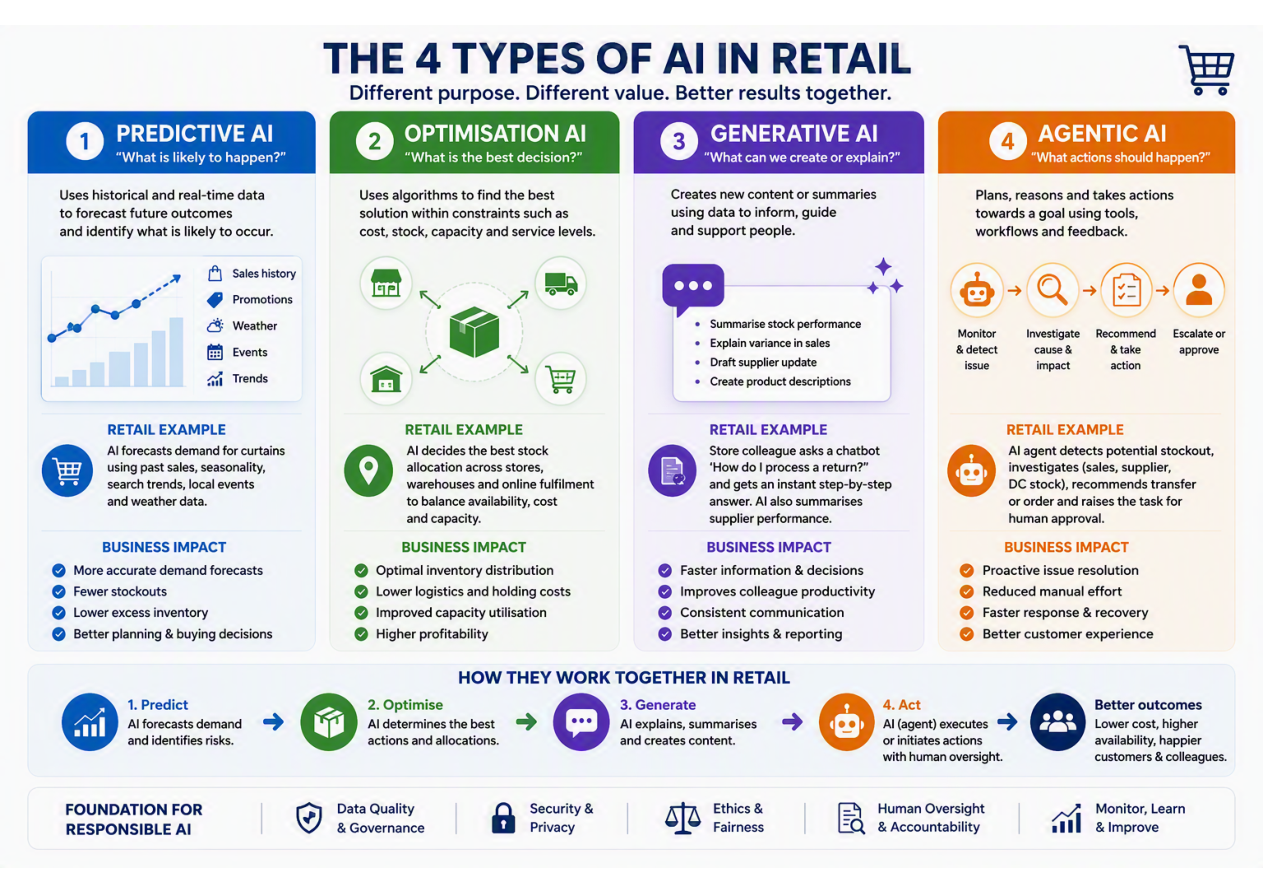
1. Predictive AI
What is likely to happen?
Predictive AI uses historical and real-time information to forecast future outcomes. Retail examples include demand forecasting informed by sales, promotions, seasonality, search behaviour, local events and weather.
2. Optimisation AI
What is the best available decision?
Optimisation AI finds the most effective response within constraints such as stock, cost, capacity and service levels. It can determine how inventory should be allocated across stores, warehouses and digital fulfilment channels.
3. Generative AI
What can be created, summarised or explained?
Generative AI can summarise performance, explain variance, draft communications and help colleagues follow approved procedures. Outputs must remain grounded in trusted information and appropriate controls.
4. Agentic AI
What actions should happen next?
Agentic AI can monitor conditions, investigate issues, recommend a response and initiate permitted actions. Authorisation, auditability and human oversight are essential.
The architecture matters
Selecting a model is only one part of an enterprise AI capability. Organisations must also address data ownership, integration, identity, security, privacy, decision authority, auditability, operations and accountability.
Download the infographicConsidering an AI-enabled retail capability?
We can help assess the use case, data, integration and governance required to move towards a credible enterprise solution.
Arrange an initial consultation